
Principles of Meaningful Learning and Teaching
Why did we do this?
At the beginning of the 2026/27 academic year, EBS took an important step towards making meaningful learning a more explicit and shared part of its educational culture by introducing seven Principles of Meaningful Learning. These principles were developed drawing on contemporary research in educational psychology, particularly evidence about the cognitive, metacognitive, motivational, and social processes that contribute to meaningful learning. The chosen principles also complement the Principles of Excellent Teaching, previously agreed upon by EBS faculty. The underlying idea is simple: good teaching and meaningful learning are two sides of the same coin. Lecturers are responsible for creating opportunities and conditions for learning, while students have an equally important role in making learning happen.
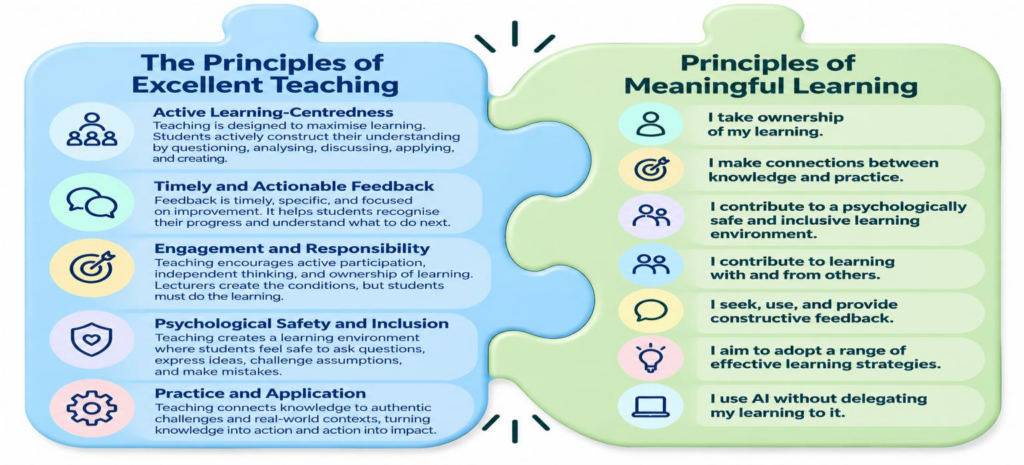
How did we do it?
In September 2026 we visited students in their classrooms. Students were introduced to the seven principles and invited to discuss their meaning before ranking them from most to least important in a short online questionnaire. The purpose of the ranking exercise was not simply to establish an order of preference, but to encourage students to engage more deeply with the principles, reflect on their significance for meaningful learning, and carefully weigh their relative importance. A total of 406 students participated, representing 41% of EBS’s 991 students. Of these, 365 were Bachelor’s students, 34 were Master’s students, and 7 were PhD students.
What do students consider most important?
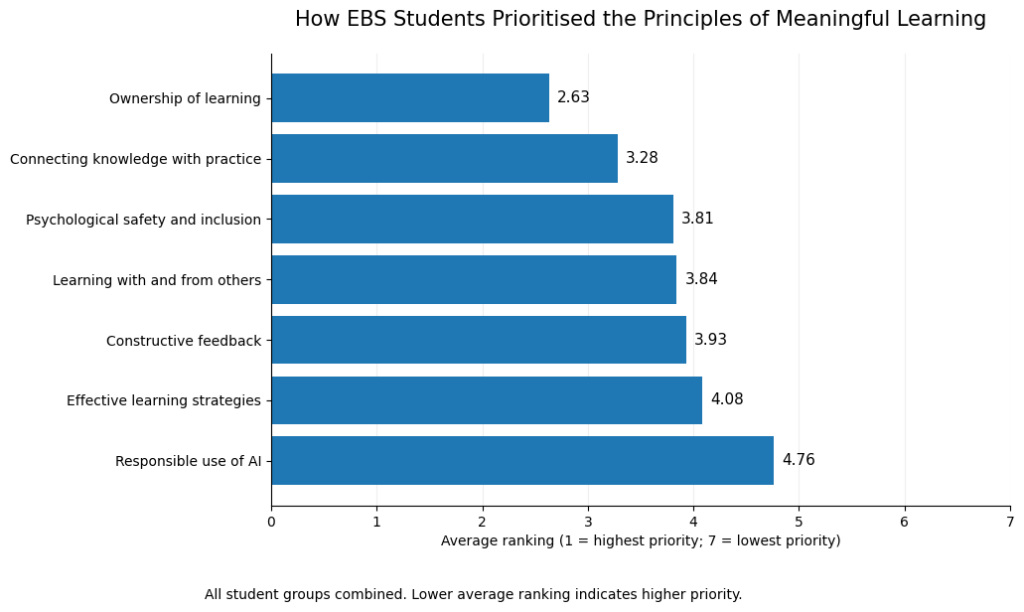
The results reveal three particularly clear patterns. Taking ownership of one’s learning emerged as the strongest shared priority, followed by connecting knowledge with practice. At the other end of the ranking, responsible AI use received the lowest relative priority. The remaining four principles received very similar average rankings, suggesting that students did not share a clear preference for one over another. Rather than indicating a meaningful hierarchy, these small differences suggest that students varied in how they weighed these aspects of learning. Importantly, a lower ranking does not mean that students consider a principle unimportant. All seven principles represent valuable aspects of meaningful learning, and students were asked to prioritise them relative to one another. The results therefore tell us more about students’ relative priorities than about the absolute importance they attach to each principle.
What can we learn from the results?
One of the most encouraging findings is that EBS students clearly recognise their own responsibility for meaningful learning. They understand that learning is not simply something that happens to them, but a process that requires their active engagement, effort, and initiative. It is equally encouraging that students place such high value on connecting what they learn with its practical application. Both priorities are strongly aligned with EBS’s strategic ambition: From Knowledge to Action, From Action to Impact. These findings also reinforce our belief that making the Principles of Meaningful Learning explicit is both valuable and necessary. By clearly articulating what meaningful learning involves, we help students focus their attention on the attitudes, behaviours, and learning practices that contribute to their development. The principles are not merely statements of good intentions. They represent expectations that EBS has of its students, just as the Principles of Excellent Teaching express what students can expect from their lecturers.
Ultimately, the aim is to make these principles a natural part of everyday learning at EBS — something students and lecturers actively refer to, reflect on, and put into practice. Meaningful learning is a shared responsibility, and these principles give us a common language for making it happen.